

When Dee first shared the opening chapter of The SpiralUp Method, the image arrived almost immediately—not fully formed, but present. As an artist, that’s often how it works. I’ll see the shape of something before the details exist, and the work becomes the process of closing the distance between the vision and the page. They rarely end up looking exactly like what was in my head, but that image is the foundation that begins a drawing.
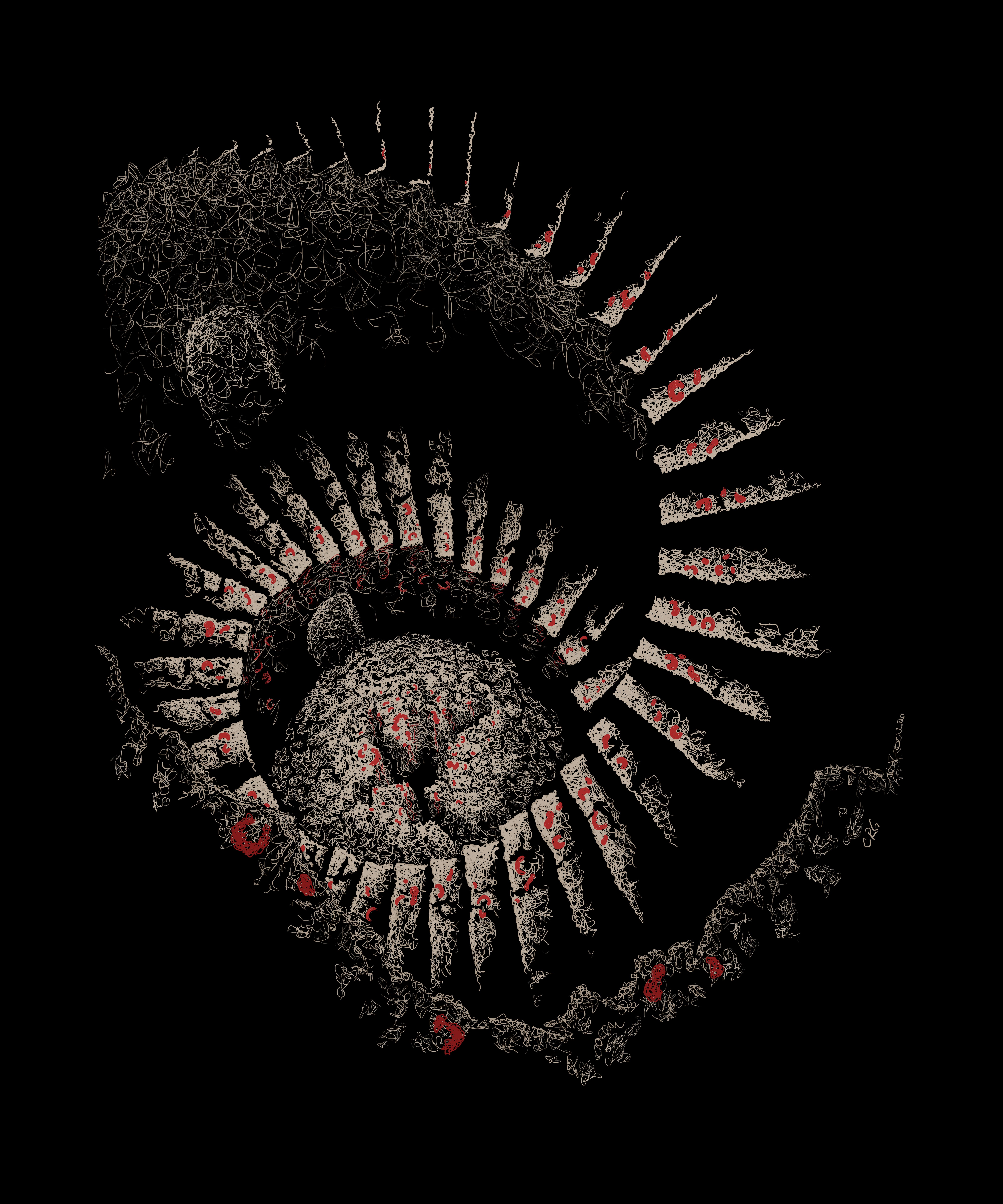
What emerged was a stone room, viewed from above and within simultaneously. At the center of the floor, a crack. Not a clean break—a jagged, spreading fracture that runs deep, deeper than the light reaches, with smaller cracks radiating outward in multiple directions the way trauma actually moves through a person. Not in one clean line, but in all directions at once.
There is blood at the point of impact—trauma is an event, and events leave marks. The blood at the base of the drawing names what happened without softening it: something struck here. Something broke. The wound is real.
Built into the walls of this room is a spiral staircase. The steps are uneven, cracked, uncertain—that is what the early steps of healing actually feel like. When we have just been fractured, the path upward does not feel solid. It does not reveal where it goes. There is no way to see the top from the bottom, and the steps themselves carry the evidence of the injury—blood on the risers, pain at every placement of the foot. Every step costs something. Every step is taken anyway.
Along the way, there are doors. This is one of the things that struck me the most in that first chapter of the Spiral Up Method: healing is not only a vertical journey. There are lateral exits at every level—rooms where other people have fallen, and other wounds that have their own pull, their own light spilling under the door. It can be genuinely tempting to step sideways into someone else’s story, someone else’s pain, someone else’s room. It is often easier than continuing to climb. The light looks warm. The effort of the next step looks enormous.
But the room is not where healing lives. The room is a detour. To heal, we have to return to the stairs.
At the lower arc of the spiral—not the bottom, but not yet the top—there is a ledge. This is a place to stop. To turn and look back down at how far the climb has already come. This moment matters because the nature of spiral healing is that progress is difficult to perceive from inside it. Step by step, the movement can feel like nothing. The ledge offers what the steps cannot: perspective. You can see the distance between where you are and where the impact happened. You can see that you have been climbing all along, even when it did not feel like it. The ledge is hope.
There is still blood on the ledge. The healing is not finished here, and the pain has not yet stopped. But it will. The steps become more even as the climb continues. The cracks in them narrow. The blood thins. The top exists, even when it cannot be seen from where you are standing.
The image does not show the top. That was intentional too. The cover of this book is a portrait of the journey. This is the spiral mid-climb. The wound is still present here. The stairs are still ahead. The ledge is offering its brief, honest rest after what was already a hard climb.
This is what healing looks like from the inside: not triumphant, not finished, not clean. It’s a cracked staircase in a stone room, with blood on the steps, and a door you chose not to walk through so you could continue your own journey, with the next step waiting.
That is enough. That has always been enough.
Keep climbing.
Chris
Click below to read the first chapter of The SpiralUp Method:
The SpiralUp Method

“Healing has never happened in a straight line for a prolonged period of time, just by the very nature of what it requires. It’s not a ladder, or a staircase you climb once and arrive at the top forever changed and unable to be touched by the same traumas again. Instead, it’s a journey to understanding what you’re made of, how you specifically survive the worst this life has to throw at you, and the structure that either sets you free or encases you in the dark. The shape is a conical helix, by the way… and it’s one I’ve named “The Helix of Healing”